
One in Four Florida Listings Has a Price Cut. The Other Three Are Doing Fine.
Sep 16, 2026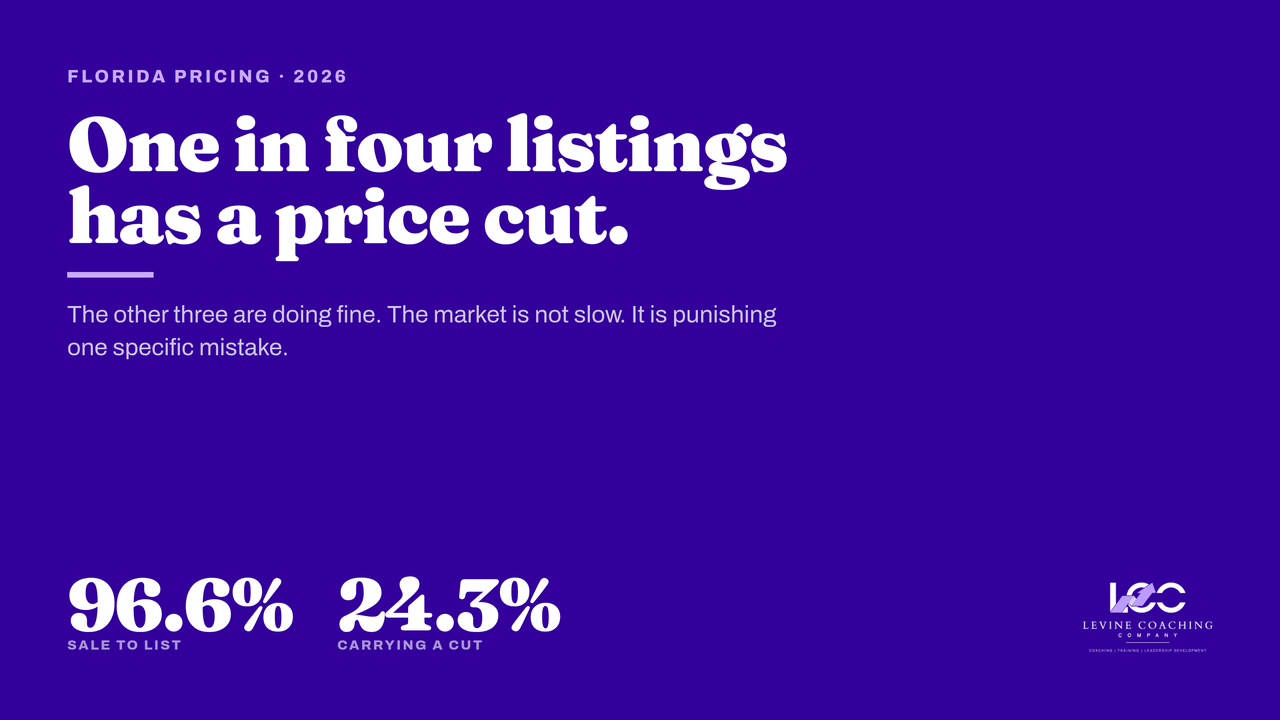
By Jeff Levine, CEO, Levine Coaching Company. Published .
Every agent I talk to tells me the same thing right now. The market is slow.
It is not, and the numbers say so plainly. What we have is a market that has gotten very good at punishing one specific mistake, and most agents are still making it at the listing appointment and then blaming the market for sixty days.
Look at what is actually happening
In August 2026, Florida homes sold at 96.6 percent of list price, up half a point from a year ago. Just under 11 percent sold above list, which is up almost two points. The share of listings taking a price drop was 20.6 percent, which is down more than a point from last year.
Read those three numbers together. Homes are selling closer to asking than they were last year, more of them are selling over asking than last year, and fewer of them are cutting. That is not a slow market. That is a market that pays a fair price when the price is right.
Now the other side. As of July 2026, 24.3 percent of active Florida listings were carrying a price reduction. Roughly one in four homes sitting on the market right now has already been marked down at least once.
So both things are true at the same time. Correctly priced homes are trading at 96 or 97 cents on the dollar and some are going over. Meanwhile a quarter of the standing inventory is stuck. That is not a market problem. That is a pricing problem, and it is concentrated in a specific set of listings.
Here in South Florida the split is just as sharp. Single family in July was 40 median days on market at 4.2 months of supply. Condos were 81 days at 9.6 months. Same counties, same buyers, same rates.
The week four math
This is the part I want every agent to memorize, because it turns pricing from an argument into arithmetic.
Realtor.com ran deed records against MLS listing histories this past June and looked at what a home actually closes for based on how long it sat. Homes that closed at the four week mark sold for 1.8 percent above the monthly average for comparable properties. Homes still going at 18 weeks closed 1.3 percent below.
That is a spread of more than three percentage points, and it has nothing to do with the house. Same house, same market, different launch.
On a $500,000 listing, three points is about $15,000. And that is measured against the final list price, which on a stale listing is already lower than where it started. So the real distance between a listing that launches right and one that launches high is wider than three points. It is three points on top of whatever you already cut.
One more number from the same work. Price reductions now peak at week six. In 2021 they peaked at week three. Sellers are holding out three weeks longer before they face it, which means three more weeks of accumulated days on market before the first correction even happens.
And the property type gap is real: condos close at 97.9 percent of final list, single family at 99.2 percent.
Why listings get mispriced
Not because agents cannot read comps. Almost every agent can read comps.
They get mispriced because of what happens in the last ten minutes of the listing appointment. The seller says a number. The agent knows it is high. And the agent decides that taking the listing at the seller's number and "working on them" later is better than losing it to the guy down the street who will say yes.
I have done it. Anyone who has been in this twenty nine years has done it. It is the single most expensive habit in the business, and here is why.
When you take a listing high, you have not won anything. You have bought yourself sixty days of unpaid work, three conversations you did not want to have, a seller who now trusts you less than they did on day one because you were wrong, and a listing that eventually sells for less than it would have if you had launched it correctly. You also gave up the chance to spend those sixty days on a listing that would have sold.
The agent who said yes to the seller's number did not beat you. They just delayed the same conversation and made it worse.
The pricing conversation that actually works
The fix is not being tougher. It is showing the seller the math before they pick a number, so the number becomes theirs instead of something you are arguing them out of.
This is where I lead with the Pricing Strategy Advisor material, because it gives you a defensible process rather than an opinion. Four moves.
One. Show the two curves, not the comps. Sellers have seen comps before and they discount them. What they have not seen is the relationship between weeks on market and final sale price. Put the week four number and the week 18 number in front of them. That is a conversation about their money, not about your opinion of their house.
Two. Price to the first two weeks, and say so out loud. Tell them exactly what you are doing and why: the goal is to be the best available option in their price band during the window when the most buyers see the listing. Not to test a number. Testing a number is what produces the 24 percent.
Three. Agree on the review date at the listing appointment. Not "we will see how it goes." A date, in writing, in the listing agreement. Day 14 we review showings and feedback, day 21 we act. When you set this up front, the price adjustment is a plan you both made, not a defeat you are delivering.
Four. Name the walk away. If the seller will not go where the data goes, say so kindly and pass. In a market at 4.2 months of supply for houses, your capacity is the scarce thing. A listing that will not sell does not just fail, it consumes the sixty days you needed for one that would have.
What to do with your current listings this week
Pull every active listing you have and write down two numbers for each: days on market, and how many showings in the last fourteen days.
If a listing is past 30 days with fewer than three showings in the last two weeks, that is not a marketing problem and more photos will not fix it. The market has already given you its answer and it has been giving it to you for a month.
Call that seller this week, not next month. Bring the week four and week 18 numbers. Tell them what the data says about waiting, which is that waiting is the expensive option and it gets more expensive every week. That call is uncomfortable for about four minutes and then it is the most productive conversation you will have all week.
And on your next listing appointment, run the process above from the beginning. One correctly launched listing is worth more than three you are dragging.
Frequently asked questions
How long does it take to sell a house in Florida in 2026?
It depends far more on pricing than on the market. In South Florida in July 2026, single family homes had a median of 40 days on market at 4.2 months of supply, while condos ran 81 days at 9.6 months. Statewide, homes sold at 96.6 percent of list price in August 2026 and almost 11 percent sold above list, so correctly priced homes are moving. Roughly one in four active listings is carrying a price reduction, and those are the ones sitting.
How much does overpricing a home actually cost?
Realtor.com analysis from June 2026 found homes that close at four weeks on market sell for 1.8 percent above the monthly average for comparable properties, while homes still on market at 18 weeks close 1.3 percent below. That is a spread of more than three percentage points, roughly $15,000 on a $500,000 home, and it is measured against the final list price rather than the original one, so the total cost of launching high is larger than three points.
When should I reduce the price on my listing?
Decide the review date before the listing goes live, not after it stalls. A workable structure is to review showings and feedback at day 14 and act at day 21. Price reductions across the market now peak at week six, compared with week three back in 2021, which means most sellers are waiting three weeks longer than they should and paying for it in accumulated days on market.
Is the Florida market slow right now?
Not uniformly. In August 2026 the statewide sale to list ratio was 96.6 percent, up half a point year over year, almost 11 percent of homes sold above list, up nearly two points, and the share of listings taking a price drop was down more than a point from the prior year. The slowness is concentrated in mispriced inventory and in condos, where reserve funding and financing questions have narrowed the buyer pool.
Should I take a listing at the seller's price and adjust later?
It is usually the more expensive choice for both of you. Taking a listing above the data buys weeks of unpaid marketing, erodes the seller's trust when the market proves you wrong, and produces a lower final sale price than a correct launch would have. It also consumes capacity you needed for a listing that would have sold. Set the review date in the listing agreement instead, so the adjustment is a plan rather than a defeat.
Let's talk
This is exactly the kind of conversation I am covering on Thursday, September 24 at 1:00pm Eastern in a free one hour session called Good Agents Ask Great Questions. It is about the questions that change the outcome of a listing appointment before you ever get to price. Register here.
If you want the longer version, the twelve week Profitable on Purpose class starts October 1 and pricing strategy is one of the modules. Details are on the program page.
Jeff Levine is a Broker Associate and Team Leader of Lux Places Group at RE/MAX Services in Boca Raton, Florida, and the Founder and CEO of Levine Coaching Company. He has twenty nine years in real estate, more than ten thousand transactions and over three billion dollars in closed volume. He is the 2026 Vice President and 2027 President Elect of Florida Realtors, a Past President of Broward, Palm Beaches & St. Lucie Realtors, a licensed Florida real estate instructor, and holds the CIPS, ABR, CRS, SRES and PSA designations.
Sources: Redfin Florida market data, August 2026; Realtor.com listing lifecycle analysis, June 2026; Florida active listing price reduction data, July 2026; South Florida MLS market data, July 2026. Figures vary by source and methodology.
Published by Levine Coaching Company.